How to deliver a real estate listing presentation that beats the AVM objection

Pricing objections have long been the hardest part of the real estate listing presentation. Sellers aren't just pushing back on numbers anymore. They’re showing up with a number already in hand, pulled from an online home estimate they found the night before. And they've usually decided it's right.
That puts agents in an interesting spot. The job used to be presenting a comparative market analysis (CMA) and walking through the comps. Now there's an extra step: helping sellers understand why an online estimate and an actual pricing strategy aren't the same thing before they've dug in on the wrong number.
The agents who handle this well aren't better at arguing. They're better at getting ahead of it. When your listing presentation already addresses what automated valuation models (AVMs) miss — the condition of the home, recent off-market sales, neighborhood nuances no algorithm picks up — you're not reacting to an online home value estimate; you're making it a footnote. Lone Wolf Cloud CMA helps with this: you can pull current MLS data and walk through the analysis live, so the conversation moves forward instead of getting stuck.
The goal isn't to win a debate with an online home value estimator. It's to show up prepared enough that there's no debate to have.
Handling pricing objections at your real estate listing presentation.
- Sellers are showing up to listing appointments with an online estimate already in hand — and they've decided it's right
- AVMs miss the stuff that actually moves price: home condition, neighborhood nuances, off-market sales, and context behind individual comps
- 63.7% of agents say pricing is their #1 listing objection — up 11 points since 2020
- The fix isn't arguing better; it's structuring your presentation so the AVM conversation is handled before the seller raises it
- Five moves that work: prepare your CMA early, lead with MLS data, curate fewer stronger comps, address AVMs proactively, and deliver in person
Why sellers bring AVM estimates to listing presentations.
Something has shifted in the listing appointment. Sellers aren't coming in with an open mind and a rough number in their head.
They're coming in with a printout.
Zestimates, Redfin estimates, neighborhood comps pulled from public portals — sellers have more pricing data at their fingertips than at any point in real estate history. And they're using it.
According to the 2026 Survey of Best Practices for CMAs and Listing Presentations, which surveyed 2,165 U.S. real estate professionals, 63.7% of agents say pricing is their #1 seller objection at the listing presentation — up from 52.7% in 2020, the single most significant shift in the survey's six-year history.
The two most common things agents hear in the room:
- "The price is too low."
- "I looked it up online, and I know it’s worth more.”

These aren't fringe objections. They're the norm. If your real estate listing presentation doesn't address them before the seller brings them up, you're walking into the appointment on the defensive.
Why an AVM isn’t the same as a CMA.
AVMs exist to give consumers a quick, ballpark sense of what a home might be worth. They're built on public data: tax records, recent sales, square footage, and general location. They don't account for:
- The condition of the kitchen or quality of a renovation
- Specific neighborhood dynamics, like noise from a highway behind the backyard
- Recent off-market activity
- Context behind a comp — a distressed sale, a divorce, an estate — that would make any agent discount it, but the algorithm accepts at face value
Agents know this. The data confirms it, too. When agents were asked which source they trust most for comps, 90.8% said their MLS. Online home value estimators? Under 1%.
But sellers don't know what agents know. They see a number on a trusted website and anchor to it. Once that anchor is set, it's difficult to move. Now the listing appointment isn't just about strategy — you're also trying to explain why the number they came in with isn't necessarily the right one.
You're not trying to prove the AVM wrong. You're giving the seller context for why your number is different.

What a strong real estate listing presentation actually looks like.
A listing presentation that handles the AVM conversation well takes more than good data. It takes structure, timing, and confident delivery. Here's how agents are doing it well.
1. Prepare early and treat the CMA as a research document.
One of the clearest shifts in the 2026 survey is that agents are preparing their CMAs earlier. Nearly half (47.9%) now create their CMA one or more days before the listing presentation, up from 35.3% in 2020. Same-day creation has dropped from 21.5% to 13.7%.
A CMA built under time pressure is a reactive document. A CMA built a day or more in advance is a deliberate one. It’s researched, curated, and ready to tell a clear story. That preparation gives you a much better chance of holding the line on price when you're sitting across from the seller.
Treat your CMA prep time as protected research time, not a checklist item. Block it out the day before, not while you're sitting in the parking lot outside.
2. Lead with MLS data, not your opinion.
When a seller comes in with an online estimate and says the number should be higher, the worst response is an argument. The best response is evidence, more specifically, MLS data that a public portal can't replicate.
Agents overwhelmingly trust their MLS above all other sources (90.8%), and for good reason. It contains the verified, detailed sales history that AVMs can only approximate. So when the seller pulls out their number, walk them through what your MLS data actually shows:
- Where the AVM data comes from, and what it can't see
- What MLS data reveals that the algorithm missed
- Why your number reflects what every serious buyer's agent will be looking at
The goal isn't to prove the AVM wrong. It's to show why your analysis is more complete.
One thing that helps here: Having pricing data that's actually current. For example, Cloud CMA pulls real-time MLS data automatically, so you're not walking in with a public estimate that's weeks or months out of date while the seller has something fresher on their phone.
3. Curate your comps — fewer, stronger, more defensible.
One of the more counterintuitive findings from the 2026 survey: agents are using fewer comps than they were six years ago. Average maximum comps dropped from 11 to 8.7 — a 26% decline. Average minimum dropped from 5 to 3.7.
This reflects a broader move toward precision over volume. A CMA with 12 loosely selected comps gives a seller room to argue. A CMA with six carefully chosen, well-explained comps tells a clear, defensible story. When a seller questions the price, you can point to each comp and explain exactly why it's there.
Comp selection also doesn't have to be locked in before you walk through the door. The 2026 survey found that agents routinely adjust comps during the listing appointment: 12.3% always add a comp on the spot, and 36% sometimes pull one up that wasn't in the original CMA. The right tools, like LiveCMA in Cloud CMA, lets you do that without breaking the flow of the conversation.
The best CMAs are curated, not comprehensive. Don't ask "How many comps can I include?" Ask "Which comps can I explain?"
4. Address the AVM in your presentation before the seller raises it.
Rather than waiting for the seller to bring up their AVM estimate, address it proactively. Build a section into your CMA that acknowledges AVM tools, explains how they work, and shows specifically why they don't account for this property's situation — then let that section anchor the pricing conversation in your real estate listing presentation.
This does two things:
- It demonstrates that you've done your homework.
- It gives the seller context before an online estimate becomes the number you're arguing about.
Sellers who feel heard, rather than dismissed, are far more receptive to evidence. Showing the seller why the AVM doesn't tell the whole story is where the CMA earns its value.
5. Deliver the presentation in person, at the appointment.
Despite the rise of virtual listing presentations (44.3% of agents have now done one, up from 29% in 2020), in-person delivery remains the strong preference — and for good reason. When a seller reviews data on their own before you're in the room, they have a chance to form an opinion before you've had a chance to provide context.
The 2026 survey found that 75% of agents still deliver their CMA at the presentation, not before. Walking a seller through the data in real time — where you can address questions, explain comps, and guide the conversation — is a fundamentally different experience than sending a PDF and hoping for the best.
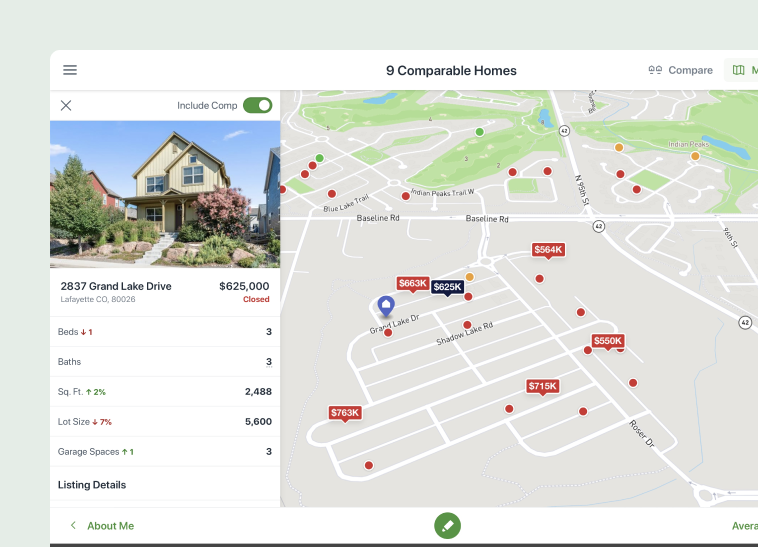
Cloud CMA's LiveCMA is designed for this moment. It supports interactive, live presentations with side-by-side comp comparisons, map views, market statistics pages, and a layout optimized for laptop or tablet in the room. Rather than flipping through a static report, you're walking the seller through a dynamic, visual analysis that's harder to dismiss and easier to understand. For a pricing conversation, that context matters.
Why getting this right is worth it.
Pricing objections don't just happen at the listing appointment. They determine who wins the listing at all. According to the 2026 survey, price disagreement is the #2 reason agents lose listings (33.6%), trailing only "seller went with another agent" (35.4%). And some of those agents who "went with another agent"? They won by agreeing to a higher price: a short-term win that typically ends in a price reduction 30 days later.
The agents who hold the line on price aren't doing it through stubbornness. They're doing it through evidence. A real estate agent listing presentation grounded in MLS data, built to address AVM questions, and delivered in person gives you something much more useful than a number: context you can defend.
The AVM may be where the pricing conversation starts. Your CMA is what puts that number in context.
If you want a repeatable process for handling pricing conversations before they become objections, Lone Wolf's free eBook Selling the Seller is worth a read. It covers comp selection, building persuasive CMAs, navigating seller expectations, and the leave-behinds that keep you top-of-mind after the appointment. Download it free here.
Listing presentations are won on proof.
Cloud CMA gives you real-time MLS data and LiveCMA presentations you can walk through with sellers in the room, so you're not just handing them a number; you're showing them how you got there.
Frequently asked questions.
What is an AVM, and why do sellers trust it?
- An AVM, or automated valuation model, is an algorithm-based tool that estimates a property's value using publicly available data like tax records, square footage, and recent nearby sales. Tools like the Zillow Zestimate are the most well-known examples. Sellers trust them because they're free, easy to access, and associated with well-known brands — even though they lack the nuance and local market knowledge that a professional CMA provides.
How do I respond when a seller says "Zillow says it's worth more"?
- Don't dismiss this. Acknowledge it, then put it in context. Explain what data the AVM uses and what it can't account for: the condition of the property, specific neighborhood dynamics, recent off-market activity, or factors that affect this home specifically. Then walk the seller through your MLS-based analysis and show them why your comps tell a more accurate story.
How many comps should I include in my listing presentation?
- Most agents use roughly 4–9 carefully selected comps. According to the 2026 Survey of Best Practices for CMAs and Listing Presentations, the average maximum is now 8.7, down from 11 in 2020. Focus on comps you can explain and defend. A few strong selections are more useful than a long list of loosely related sales.
Should I send the CMA before the listing appointment?
- Not necessarily. Most agents (75%) deliver their CMA at the presentation rather than in advance. That allows you to explain the comps, answer questions, and put the pricing recommendation in context. Preparing the CMA one or more days in advance (as 47.9% of agents now do) is still worthwhile and gives you more time to research and refine your analysis.
Is pricing really the #1 seller objection?
- Yes, and it's not close. The 2026 survey shows 63.7% of agents cite pricing as their #1 seller objection — up from 52.7% in 2020. Commission objections, while still present, have declined as a share since the 2020 survey. Pricing is where the conversation most often gets stuck, which is why a strong listing presentation built around your CMA is so important.
Source: 2026 Survey of Best Practices for CMAs and Listing Presentations, Giant Steps Advisors & Lone Wolf Technologies. Based on responses from 2,165 U.S. real estate professionals surveyed November 2025 – February 2026.
Other resources
See more eBooks, webinars, and blog articles to help you stay ahead with strategies designed for your success.